Remote Login / Internal IT teams
Remote access software for internal IT teams
Remote access software for business has to satisfy the colleague waiting for help and the reviewer asking who had access. Remote Login gives internal IT teams a visible session, a defined access window and an organisation-scoped record.
Remote Login
You are supporting colleagues, not customers — the risk is different
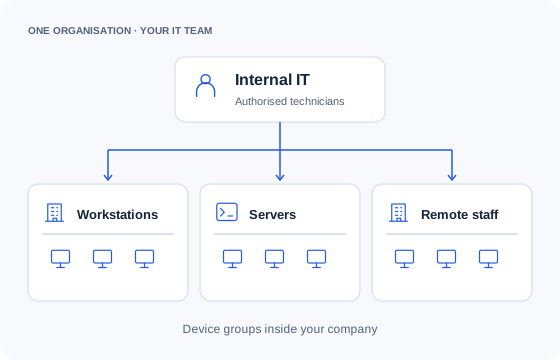
Inside one business, the question is rarely whether IT should help. It is which technicians can reach which devices, how an employee knows a session is legitimate, and what remains available when someone reviews it later. A familiar company name does not remove the need for clear permissions.
Employees may have confidential material open on their screens. A remote support session can expose that material to the technician while the problem is being fixed. Give people a chance to prepare the desktop, understand the request and decline or end an attended session when appropriate.
Unattended access belongs in a different policy. Servers and approved maintenance windows may need it; a user’s workstation should not gain it merely because the agent can be installed there. Decide who can authorise that mode and document the scope for your own environment.
Remote Login is the access layer. Your identity lifecycle, endpoint security, incident process and records policy remain part of the deployment. The aim is to make those responsibilities explicit enough to review, rather than bury them under a statement that the product is “enterprise secure.”
Remote Login
The questions your security review will ask
Who can connect, and how is that decided?
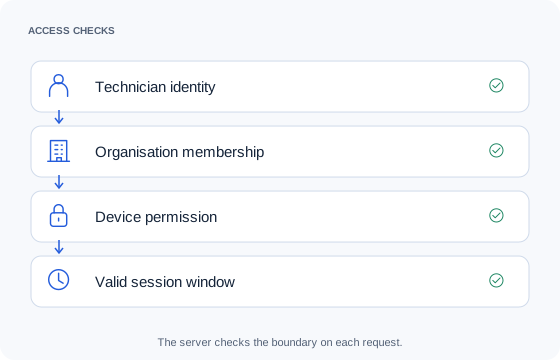
The server derives the current technician role and organisation membership when authorising a request. A role supplied by the browser is not authority. Technicians should use individual identities and TOTP two-factor authentication so that access is attributable to a person.
A pilot should include an account with limited permissions. Testing every workflow while signed in as the owner tells you little about how the boundary behaves for ordinary staff. Define the smallest set of people who need each device group before broad deployment.
What does the person at the desk see?
For attended support, the person sees a request identifying the technician and provider, the target device and the access duration. They can accept or refuse. While connected, the session remains visible. There is no invisible monitoring mode.
Explain the prompt to employees in the rollout notice. Tell them how to verify an unexpected request with IT using a known channel. Familiarity with the expected support experience helps a real consent decision, especially when an employee is under pressure to resolve an urgent problem.
What is retained, and for how long?
The session record includes access metadata such as participants, device and timing, with relevant activity events. It is distinct from a full recording of screen contents. Retention depends on the data category and account arrangements described in the Privacy Policy; confirm your exact requirement before purchase.
Do not put a made-up number in a security questionnaire because a field requires one. If your policy needs a fixed retention term, deletion commitment or recording configuration, agree it explicitly with the operator and document the result.
What happens the day someone leaves?
Offboarding should remove the technician’s service access, revoke relevant links and review active work. Current authorisation checks protect later requests, but the operational checklist must also cover identity-provider accounts, devices and other tools. A remote support product does not know that an HR event occurred unless your process acts on it.
Send the reviewer the full authorisation and consent model, the data-handling policy and the acceptable-use rules. These describe mechanisms and responsibilities, not a certification we have not earned.
Remote Login
One organisation, one bill, no per-seat surprises
Starter costs $25 per technician per month and includes 100 devices per seat for one organisation. Four technicians supporting 350 devices fit within its 400-device allowance for $100 per month. The same four seats supporting 600 devices need a different capacity choice.
Agency provides 250 devices per $45 seat. White-Label Pro provides unlimited devices per $75 seat. You do not have to be a reseller to need a larger device allowance. Compare the plan against the whole supported fleet rather than assuming that an internal team always belongs on Starter.
The remote access software pricing calculator includes an organisation choice so that a single-company team can see the appropriate result. It uses your selected technician count exactly, without adding spare seats to manufacture a lower price.
Separate the subscription budget from rollout effort. Permissions on Macs, tests on representative Linux desktops, employee communications and ownership of unattended access all take work. The printed seat price makes the product cost predictable; it is not a claim that a fleet deploys without preparation.
Remote Login
Rolling it out without a change-management project
Begin with a small, varied pilot. Include a standard employee workstation, a Mac if the fleet has them, a system behind the network restrictions your colleagues actually use, and a server where unattended work is authorised. The goal is to discover meaningful differences early, not to collect many identical successful installs.
- Identify who owns each pilot device and who authorises the access mode.
- Use the guided enrolment path to place it in the correct organisation.
- Verify screen, pointer and keyboard separately on supported desktops.
- Run an attended session that is accepted and one that is declined.
- Check expiry and revocation before using the tool for an urgent job.
- Review the resulting record with the person responsible for security or support operations.
Use the three-step setup and session guide as the rollout outline and the platform matrix as the acceptance checklist. These give an employee-facing explanation and a technician-facing reference that agree with each other.

Document the actual outcome for the pilot fleet. “macOS supported” is less useful than “screen viewing passed, Accessibility was granted, keyboard and pointer tests passed on the approved configuration.” The latter tells the next technician what was proved and what a later permissions change could invalidate.
Once the pilot meets your requirements, expand in controlled groups. Keep the previous access route available for recovery until you have proved the replacement. Removing the working tool first turns a reversible evaluation into an avoidable support outage.
Give the rollout a named owner inside the business. That person should collect the pilot results, resolve outstanding review questions and approve the next group of devices rather than leaving expansion to whichever technician happens to have time.
Questions, answered
Questions internal IT teams ask
Is Starter enough for an internal IT team?
Starter can fit a single organisation with up to 100 devices per purchased technician seat. A four-seat team has a 400-device allowance. A larger fleet can use Agency or White-Label Pro even if it does not resell support. Compare capacity and required features together.
Does Remote Login make our deployment compliant?
No product can establish your organisation’s compliance by itself. Remote Login provides access controls, consent mechanisms and records that can support your process. Your authority to access devices, identity lifecycle, data handling, configuration and contractual requirements still need their own review.
Can we support employees’ iPhones?
You can provide attended support using screen sharing that the person starts, with a pointer overlay and chat. The technician cannot tap or type into the iPhone through Remote Login. Treat viewing and control as different capabilities when writing the service desk’s support scope.
What should we evaluate first?
Start with the actual support workflow, then test your platforms, consent outcomes, organisation permissions and records. Bring a reviewer into the pilot before a fleet-wide rollout, so an unanswered retention or access question is resolved while the deployment is still small.
Get started
See how it fits your team.
Tell us how many technicians you have and which platforms you support. We will help you check the fit.