Remote Login / MSPs and IT providers
Remote IT management software for managed service providers
Remote IT management software should leave room for the next client. Remote Login is the remote access layer for managed service providers: one technician price, separate client organisations, visible support sessions and an audit record.
Remote Login
Per-endpoint pricing bills you more for winning work
Every tool priced per endpoint charges you more as the managed fleet grows. Sometimes that model is appropriate: a monitoring product does more continuous work when another endpoint joins. For remote support, we chose a different unit. The people providing the service determine the seat count, and each seat brings a published device allowance.
Agency costs $45 per technician per month and includes 250 devices per seat. Ten technicians pay $450 for capacity up to 2,500 devices across unlimited client organisations. Adding a clinic’s forty workstations inside that allowance does not add forty line items to your bill.
This is a capacity allowance, not a claim that a ten-person team can support an unlimited fleet on Agency. Above 2,500 devices, that team can change the seat count or move to White-Label Pro. There is no surprise overage meter that silently changes the cost of the account.
Start with your technician and device numbers, then compare the result with the actual unit on your current invoice. A named technician and a concurrent technician are not interchangeable. If only a small fraction of a large team works at once, concurrent licensing may be cheaper.
Remote Login
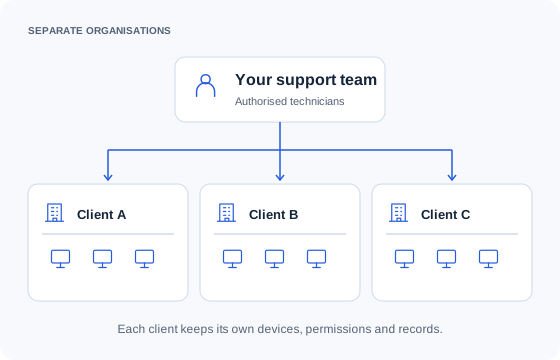
One console, every client organisation, no leakage between them
Hard tenant isolation, and what that means in practice
Each client’s devices and sessions belong to that client’s organisation. The server derives permissions from the current account and membership rather than trusting a client-supplied organisation identifier. A technician working for one customer should not be able to retrieve another customer’s device simply by changing an ID.
The boundary matters during routine work as well as adversarial requests. Device naming conventions help people choose the right target, but names do not replace authorisation. Before a rollout, test the organisation memberships with accounts that have different levels of access, not only with the owner account that can see everything.
Onboarding a new client
Create the client organisation, assign the appropriate technicians, and enrol devices into that boundary through the guided setup flow. Check screen, pointer and keyboard capability on a representative workstation. Establish who authorises unattended access and who can stop or revoke a session.
An organisation is a security boundary and a useful unit for the customer’s records. It should not be a miscellaneous folder containing devices from unrelated businesses. Keeping the structure clear when the fleet is small is easier than disentangling records after growth.
Read the tenant isolation and authorisation model and the enrolment workflow before setting up the first customer.
Remote Login
Where this sits next to your RMM
Remote Login is not an RMM. It does not provide patch management, monitoring or alerting. If you already use NinjaOne, Atera, Datto or another system for those jobs, keep the tooling that meets those needs. Remote Login handles the authorised connection to a device and the record around that connection.
This distinction matters to the budget as much as to the feature list. Replacing a remote access component is one decision; replacing endpoint management is another. Do not subtract an entire suite’s cost from your operating budget if you still need its inventory, policies, monitoring or automation.
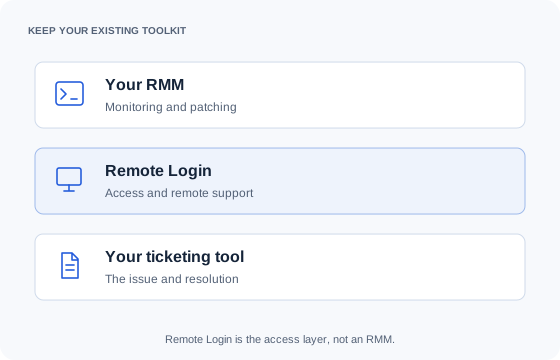
We do not imply that a product integration exists because the two products can run in the same organisation. Plan any ticket handoff, deployment process or identity integration explicitly. If a particular integration is mandatory, bring it to the evaluation before committing to a migration.
Consider a provider adding a new forty-device customer to a five-seat Agency account that currently has 900 devices. The account’s allowance is 1,250 devices, so the new total of 940 fits without a capacity purchase. Create a separate organisation for that customer and assign its technicians deliberately. The commercial allowance answers whether there is room; it does not decide which staff should have access.
Now consider a customer group with several related businesses. Common ownership does not automatically mean every employee or technician should see every device. Choose the organisation boundaries according to the actual authority and reporting requirements. If the businesses need separate records or access policies, do not collapse them into one organisation simply to simplify a device list.
A provider can also have different support commitments across clients. One permits agreed unattended server maintenance, while another requires attended acceptance for workstation work. Keep those agreements explicit during onboarding. Unlimited client organisations means you can represent those relationships without adding an organisation fee; it does not mean one customer’s permission carries over to the others.
That is the operational reason to examine the tenant model alongside the invoice. Review those boundaries when client contracts change, when staff move between teams and when organisations merge or split. A cheaper access path is not a useful saving if the team cannot confidently explain which client it belongs to or produce the corresponding record.
The remote support platform overview describes the actual product. Our narrower scope is useful when you want to buy that layer deliberately, with printed limits, instead of paying for a suite you will not use.
Remote Login
Sell it under your own name
Agency includes branding; White-Label Pro includes full white-label. Your client should recognise the provider helping them. See what you can rebrand for the customer-facing surfaces and the boundaries that remain.
Branding does not make the software’s publisher or legal operator disappear. Signing identities, operating-system permission prompts and legal notices can retain technical or operator information. Test the installer, setup, support request, session and notification surfaces before you describe the experience to a customer as fully yours.
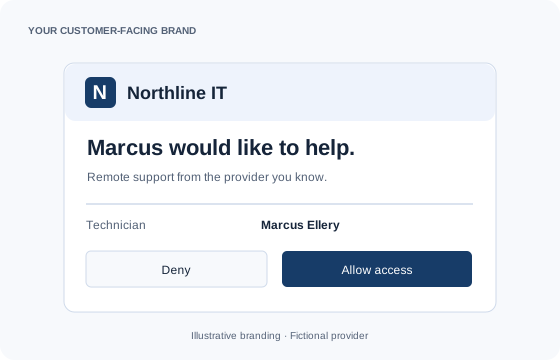
There is no separate rebranding fee on a plan that includes it. Starter is intended for one organisation and does not inherit the Agency branding entitlement merely because a logo file exists. Select the appropriate plan before incorporating the service into your own offering.
Remote Login
What your client sees — and why that is a sales asset
The customer sees a request that identifies the technician and provider, names the target device and states the duration. During an attended session, the person at the desk can see that access is active and can end it. Afterwards, the provider can identify the visit in the organisation’s record.
That is useful material for your own service proposal. It describes the experience a practice manager or office administrator can expect without asking them to understand remote protocols. It also sets a clear boundary: an unexpected support request is something they can refuse and check with your team.
Include that explanation in onboarding. Tell staff which provider name to expect, how to verify an unusual request, and how to contact you through an independent channel. A technical consent prompt works best when the people seeing it have enough context to make the decision.
The end-to-end branded support journey lets you examine this as your customer will see it. For the full session narrative, use the technician and customer views side by side.
- Technician
- Marcus Ellery
- Organisation
- Northline Dental
- Device
- FRONTDESK-01
- Started
- 09:41:07 UTC
- Ended
- 09:41:33 UTC
- Transfer event
- 2 files
session.ended · record retained
Remote Login
What ten technicians actually pay
| Plan | 10 technician seats | Included device capacity | Client organisations |
|---|---|---|---|
| Starter | $250/month | 1,000 | One |
| Agency | $450/month | 2,500 | Unlimited |
| White-Label Pro | $750/month | Unlimited | Unlimited |
The calculation is price per seat multiplied by ten. There is no annual prepayment hidden in the monthly figures above. An MSP with multiple clients should compare Agency and White-Label Pro; Starter’s one-organisation limit makes it unsuitable for that structure even when its device allowance would fit.
For a current vendor comparison, read Remote Login and ScreenConnect and the remote support licensing guide. In particular, ScreenConnect Standard includes unlimited unattended agents. A separate device charge is not a valid assumption for every ScreenConnect deployment.
A migration calculation should include the overlap period, technician familiarisation and re-enrolment effort as well as subscriptions. Predictable pricing makes that calculation easier; it does not make deployment work disappear.
Questions, answered
Questions MSPs ask first
How many client organisations can one seat cover?
Agency and White-Label Pro include unlimited client organisations. Starter includes one. Device capacity is calculated separately: 250 devices per Agency seat, 100 per Starter seat and unlimited on Pro. Every organisation remains subject to its own access boundary.
Can a client see another client’s devices?
Client devices and records are scoped to their organisation. Server-side authorisation checks the requester’s membership and permitted action. Do not use a single shared organisation as a substitute for separate clients; that would undermine the structure the product provides.
Can I rebrand the agent installer?
Check the exact installer and operating-system surfaces during evaluation. The supported branding does not imply that code-signing publisher identities or every binary name changes. The white-label scope explains why those edges must be inspected before you promise them to a client.
What happens when a technician leaves?
Remove the technician’s access and review active sessions, shared links and organisation memberships as part of offboarding. The server uses current permissions for subsequent authorised requests. Do not assume that changing a payroll record or deleting an email account automatically performs every remote-access revocation.
Do you charge per device?
There is no metered per-device overage. The plan includes a device allowance derived from the purchased seats, or unlimited devices on Pro. If you need more capacity, choose additional seats or a different plan; the allowance is not an invisible second bill.
Can I migrate from ScreenConnect or TeamViewer?
Yes, you can evaluate Remote Login alongside your current service and enrol a pilot group. There is no claim of a one-click agent or audit-history import. Validate your actual platforms, enrol the replacement agent deliberately, preserve required records and retire old access only after the replacement is proven.
Get started
See how it fits your team.
Tell us how many technicians you have and which platforms you support. We will help you check the fit.