Platform reference / iOS and iPadOS
Can a third-party app remote control an iPhone? No.
Not with Remote Login or another third-party support app: iOS does not expose public system-wide touch injection to those apps. Apple’s own FaceTime remote control is a separate feature. Here is the boundary between remote viewing, control and device management.
Remote Login
The short answer
Third-party remote support software cannot take over an iPhone’s system interface and tap through arbitrary apps. Remote Login therefore provides attended screen sharing and guidance, not iPhone control. The person holding the phone performs the actions and can stop sharing.
There is an important first-party exception: Apple documents remote control in supported FaceTime calls. Both participants must meet Apple’s requirements, including supported system versions and the contact relationship; availability also varies by region. That feature belongs to Apple’s own service. It does not supply a general input API to commercial support apps.
So the useful question is not simply “Can I remote control iPhone screens?” It is “Through which product, on which system, and with which permissions?” The answer should name the mechanism. A video of one Apple feature is not evidence that another vendor can offer the same interaction.
Remote Login
What iOS actually permits
ReplayKit and broadcast screen sharing
Apple’s ReplayKit documentation describes screen recording and broadcasting. A sharing flow can transmit screen content to a viewer after the user starts it. Capture APIs evolve between OS versions; the supported capture path still does not imply permission to inject input into other apps.
For the support participant, that means they choose to share and remain responsible for the taps and typing. What is visible on the shared screen can be visible to the technician, so prepare the device for the session and stop sharing when the support task is complete.
Why the sandbox forbids synthetic input
A third-party application operates within the access Apple permits. It cannot promote itself into a system-wide controller that taps through unrelated applications. Screen broadcast and remote input are separate capabilities; receiving pixels does not create permission to send system-wide touch events.
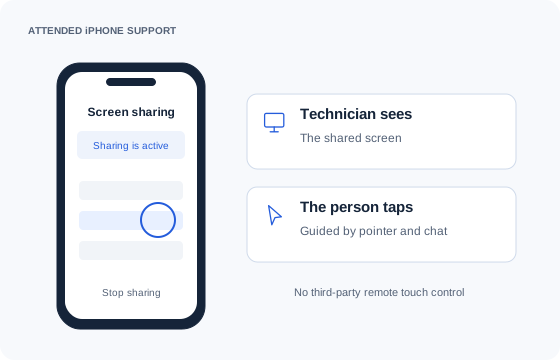
A pointer drawn over a shared view is useful guidance, but it remains an annotation. If a technician points at Settings, the person holding the iPhone must open Settings. Advertising that overlay as touch control would erase the most important distinction in the workflow.
What MDM can and cannot do
Apple device management supports administrative tasks such as configuration and managed commands, with scope depending on enrolment and supervision. Administration is not the same as an interactive session that drives every app’s interface.
Ask which specific management command is being offered. Configuring a setting or remotely erasing an authorised managed device is a different task from moving a finger around a live customer screen. Supervision should not be treated as a blanket promise of arbitrary remote touch control.
Remote Login
What you can genuinely do when supporting an iPhone
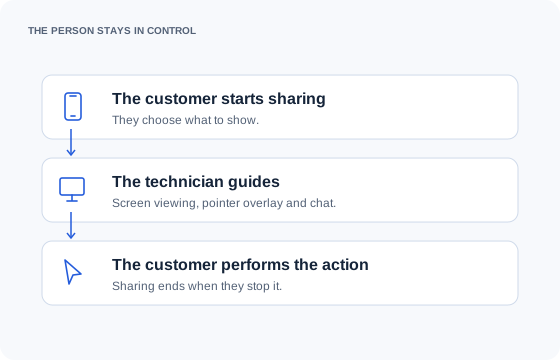
In Remote Login, the customer starts attended screen sharing. The technician sees the shared screen, uses an on-screen pointer ring to indicate a location, and can communicate through chat. The customer carries out each tap or typed action. Sharing ends when the customer stops it.
That workflow can still be useful for explaining an application setting, finding a visible error or checking that the user has reached the right screen. It also makes the division of responsibility clear: the support technician guides; the device owner acts.
Plan for the person to be available. This is not unattended maintenance of a phone left in a drawer. If the user cannot perform the required action, recognise the limit and arrange an appropriate local or Apple-supported assistance path. Renaming screen sharing “full remote access” would not solve that problem.
Compare the full platform matrix when your service covers both desktops and phones. A desktop control workflow should not be copied into an iOS service promise without changing the steps.
Remote Login
How to spot a product that implies otherwise
Read the capability verb, not just the platform name. A vendor can truthfully support iOS while offering viewing, device administration or an iPhone-based technician client. None of those descriptions establishes control of the customer’s iPhone.
- Ask whether “iOS support” means connecting from an iPhone or helping someone using one.
- Ask who performs the actual taps: the remote technician or the person at the device.
- Request a demonstration of the exact target application, not just a pointer drawn over a video.
- Ask whether the workflow needs a first-party Apple feature, supervision, special hardware or another condition.
- Check what happens when the device owner stops sharing.
- Get the supported OS versions and restrictions in writing before promising the service to a customer.
These questions are useful for every vendor, including us. A supported action should survive a precise description. If an answer keeps returning to “manage any device” instead of showing who performs the input, the control question remains unanswered.
Remote Login
What about iPadOS?
The same third-party control boundary applies to iPadOS. A larger display, attached keyboard or Apple Pencil does not give a remote support application a system-wide input-injection API. Remote Login’s iPad workflow is attended sharing and guidance.
Apple’s own supported FaceTime control should again be described separately. Check Apple’s current participant, OS and regional requirements for that feature rather than treating it as a capability of the remote support platform.
For an IT team, the useful deliverable is a service definition: which devices can be viewed, which can be controlled, when the owner must be present and what the record contains. That is more actionable than a blanket claim of mobile compatibility.
Remote Login’s IT support workflow makes those boundaries explicit. Ask us about your fleet if a particular support action is essential, and check the published plans before an evaluation.
Questions, answered
Frequently asked
Can I control an iPhone without the owner starting a session?
Remote Login does not offer unattended iPhone control. Its iOS support is attended sharing initiated by the user. Claims about a separate device-management command or Apple’s own first-party features should not be mistaken for permission to operate the full interface through a third-party support app.
Does a technician’s pointer actually tap the phone?
No. The pointer is a visual guide over the shared view. The person at the phone performs the tap. This distinction allows useful assistance without implying that the technician has input privileges the operating system does not give the application.
Does this apply to every product?
It applies to the public third-party app capability discussed here. Apple’s own FaceTime remote control is an explicit exception to any claim that no remote iPhone control exists at all. Always identify the product and mechanism before generalising.
Get started
Know the limits before you connect.
Tell us how many technicians you have and which platforms you support. We will help you check the fit.