Remote Login / Platform capabilities
What remote access can actually do on each platform
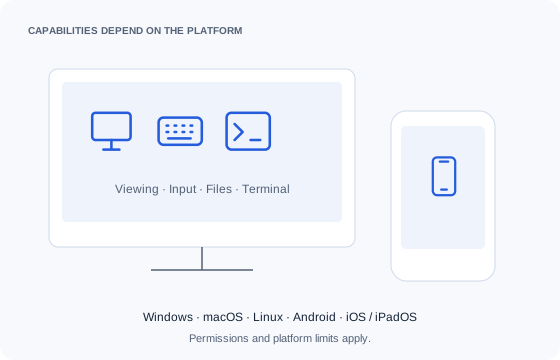
Remote access software platform support is a set of capabilities, not a row of logos. Here is what Remote Login can do on Windows, macOS, Linux, Android, iOS and iPadOS, including the permissions and limits that change the answer.
Remote Login
The capability matrix
“Yes” means the capability is available in a supported, correctly configured deployment. A qualified cell explains the dependency; select it to see the mechanism. “Not possible” refers to third-party Remote Login control on the indicated operating system, not to a promise about every first-party or laboratory tool.
This reference describes the product’s intended support surface. It is not a certification of every OS version, hardware model or display-server configuration. Test the actual devices in your fleet before promising a capability to their users.
| Capability | Windows | macOS | Linux | Android | iOS / iPadOS |
|---|---|---|---|---|---|
| Unattended control | Yes | macOS requires Screen Recording for viewing and Accessibility for input; the person at the Mac grants these in System Settings. | Linux graphical control depends on the desktop session and display server. Verify the target configuration; headless systems can use the terminal. | Android control depends on device ownership, permissions and supported management configuration. A consumer handset does not imply unattended control. | Third-party support apps cannot inject system-wide touch or keyboard input on iOS or iPadOS. Apple’s own FaceTime remote control is a separate feature. |
| Attended screen viewing | Yes | macOS requires Screen Recording for viewing and Accessibility for input; the person at the Mac grants these in System Settings. | Linux graphical control depends on the desktop session and display server. Verify the target configuration; headless systems can use the terminal. | Yes | The person at the device starts screen sharing and can stop it. Viewing a broadcast does not grant control. |
| Remote keyboard + pointer | Yes | macOS requires Screen Recording for viewing and Accessibility for input; the person at the Mac grants these in System Settings. | Linux graphical control depends on the desktop session and display server. Verify the target configuration; headless systems can use the terminal. | Android control depends on device ownership, permissions and supported management configuration. A consumer handset does not imply unattended control. | Third-party support apps cannot inject system-wide touch or keyboard input on iOS or iPadOS. Apple’s own FaceTime remote control is a separate feature. |
| File transfer | Yes | Yes | Yes | Only files exposed to the app through the operating system’s sharing mechanisms are available; there is no unrestricted device filesystem. | Only files exposed to the app through the operating system’s sharing mechanisms are available; there is no unrestricted device filesystem. |
| Terminal | Yes | Yes | Yes | Android control depends on device ownership, permissions and supported management configuration. A consumer handset does not imply unattended control. | iOS does not expose a system shell to a third-party remote support app. |
| Live phone screen share | Browser viewer | Browser viewer | Browser viewer | The person at the device starts screen sharing and can stop it. Viewing a broadcast does not grant control. | The person at the device starts screen sharing and can stop it. Viewing a broadcast does not grant control. |
Owner: Houston IT Developers LLC. Reviewed 22 September 2026. Review again with each major operating-system release and whenever the agent’s permission model changes. The review date and source stay with the table so that a copied screenshot keeps its context.
Remote Login
Windows
Windows supports the desktop access pattern most IT teams expect: attended viewing, keyboard and pointer control, unattended maintenance where authorised, file transfer and terminal access. The enrolled agent and technician’s permission determine whether a particular machine can be reached.
“Windows supported” still does not answer every deployment question. User accounts, endpoint policy, privileged prompts and network restrictions can change the session experience. Test the task that matters to your team, including any administrator workflow, rather than stopping when a desktop first appears.
Separate the person connecting from the account used inside the remote operating system. A support technician’s Remote Login identity explains who opened the session; local Windows permissions still govern the work on that computer. The existence of a connection is not a grant of administrator rights.
For planned unattended work, identify who authorises that mode and which devices it covers. Servers and staff workstations may have different policies. A single working installer should not quietly become a blanket policy for the whole fleet.
Remote Login
macOS — and the permissions that trip everybody up
On macOS, screen viewing and input are separate permissions. Screen Recording allows the relevant app or agent to capture the display. Accessibility permits the input interaction needed for control. Granting one does not prove that the other is present.
This is why a session can look connected while the technician cannot move the pointer or type. It is also why “the agent installed successfully” is not an adequate acceptance test. The setup process must verify the screen, pointer and keyboard as distinct outcomes.
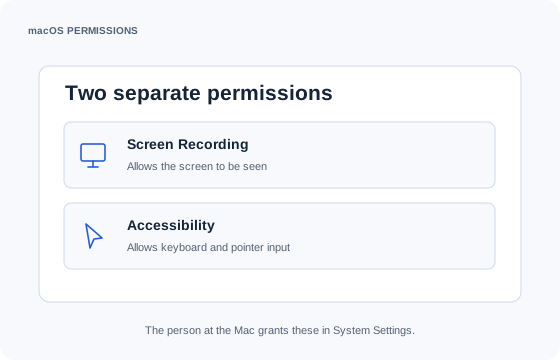
Apple documents screen and system audio recording permission as a user-controlled setting. The exact labels can vary by macOS release. Follow the setup instructions for the installed version and have the person at the Mac approve the correct application identity.
App and agent updates can affect permission identity. If the screen or input stops working after a binary change, inspect the current grants before treating the result as a network fault. Repeating an install without checking which app has permission can leave the same failure in place.
The practical pilot is simple: view a non-sensitive test desktop, move the pointer, enter text in a safe test field and confirm the local user can stop the session. Record those results. A badge should reflect those checks, not assume them from the device’s operating-system name.
Remote Login
Linux
Linux support has two distinct cases: a graphical desktop session and a headless system. For a server without a desktop, terminal access may be the useful capability. For a workstation, display-server and session details matter. Do not promise universal graphical control merely because both devices run Linux.
A desktop environment can restrict screen capture or input differently from another environment on the same distribution. Session ownership, graphical login state and system policy also matter. That is why the matrix says session dependent instead of presenting an unconditional green tick.
During a pilot, document the distribution, desktop environment, display server and the state in which the test ran. A successful session while a user is logged in does not, by itself, establish unattended control at the login screen. Test both only when both are part of the required support scope.
Remote Login’s capability verification step is meant to expose those distinctions. Choose a terminal workflow when it is the appropriate supported route, and leave an unsupported graphical action clearly labelled instead of having technicians discover it during an outage.
Remote Login
Android
Android viewing and control depend on the device’s ownership, permissions and supported management configuration. An organisation-owned managed device is not equivalent to an employee’s personal phone. Manufacturer and OS-version differences can affect what a remote support app may do.
For attended sharing, the person at the device starts the sharing flow and retains a way to stop it. Remote input and unattended access require a supported configuration; they should not be inferred from the fact that the screen is visible.
Build a small test list that represents the actual fleet: manufacturer, model, OS release and management state. Ask for the precise action you need—viewing, tapping, typing or returning when no user is present—and verify it separately. A product that works on one managed model has not automatically demonstrated the same capability on all Android devices.
For personal devices, explain the scope to the owner before the session. Showing a work-app problem may expose notifications or other content on the screen. Keep the support task narrow and let the person stop or prepare the display as needed.
Remote Login
iOS and iPadOS — what is genuinely impossible
Remote Login cannot remotely tap or type into an iPhone or iPad. Third-party support apps do not have public system-wide input-injection access. Attended screen sharing, a pointer overlay and chat can help the user perform the steps, but they do not turn viewing into control.
Apple’s own FaceTime remote control is a separate first-party feature available in supported calls and regions. Its existence is why an unqualified statement that “an iPhone can never be controlled remotely” would be wrong. It does not make that function available to Remote Login.
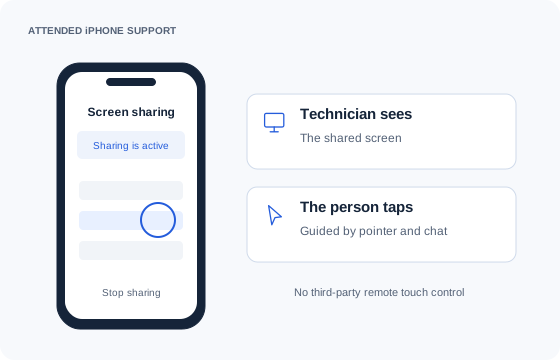
Our iPhone and iPad support reference explains screen broadcast, the distinction from device management, and questions to ask a vendor making a broad mobile-support claim. Read it before buying any support product specifically to control an iPhone.
Remote Login
Why vendors are vague about this
A platform list is easy to scan, so it compresses several different capabilities into one word. “iOS supported” can mean that an iPhone can act as the technician’s viewer, that a customer can share a screen, or that a device can be enrolled for management. Those are three different claims.
The commercial temptation is to let the reader supply the most generous interpretation. The problem comes later, when the support team has already promised something to an end user. Precise language moves that conversation earlier, while the buyer can still make a useful choice.
We publish separate capability rows because a limitation belongs beside the positive claim it qualifies. It should not take a sales call to discover that a phone cannot accept remote input. Equally, a limitation should not obscure useful supported work: attended guidance can still solve a real problem.
Remote Login
How we verify capability instead of assuming it
Guided enrolment checks the actual screen, pointer and keyboard path on a device rather than treating installation as proof of control. A device that only supports viewing should be labelled as such. That gives the next technician useful information before a session begins.
Verification is evidence for the tested state, not an indefinite guarantee. OS updates, agent changes, permission revocation and session configuration can invalidate an earlier result. When something changes, repeat the relevant check and use the current outcome.

This is also a useful procurement method. Ask a vendor to demonstrate a refusal, a missing permission and an expired session alongside its successful connection. The behaviour at those boundaries tells you more about day-to-day reliability than another identical successful desktop demo.
See how this works in a support team, how capability differs from authorisation, and the plans that include it. An operating system’s permission to perform an action and a technician’s authority to do it are separate checks.
Questions, answered
Platform questions
Does a green online status mean I can control the device?
No. Online status indicates reachability, not every capability or permission. Screen viewing, pointer input and keyboard input need their own verification, and the technician still needs authorisation in the correct organisation. Use the capability result for the action you need.
Why can I see a Mac but not control it?
Screen Recording and Accessibility are distinct macOS permissions. A device can allow display capture while refusing remote input. Check that the current agent has the appropriate grants and repeat pointer and keyboard verification instead of assuming that a visible screen proves full control.
Can you control every Android phone?
No. Android control depends on ownership, management configuration, permissions and supported device behaviour. Test representative devices from the real fleet. An organisation-managed device does not establish what will work on an unrelated personal handset.
Is this matrix a promise about every OS version?
No. The matrix describes capabilities and their principal conditions. An evaluation still needs to establish support for your particular OS release, hardware and configuration. The dated reference is updated as those boundaries change; a platform name alone is not a complete compatibility specification.
Get started
See how it fits your team.
Tell us how many technicians you have and which platforms you support. We will help you check the fit.