Remote Login / Security and consent
Remote access earns trust, or it earns nothing
Secure remote access software needs more than an encrypted connection. It needs authority to begin, a visible boundary while it runs, and a record afterwards. This is the Remote Login model, including what remains your responsibility.
On this page
Remote Login
Tools in this category get abused when they are quiet
Remote support gives one person a view into another person’s computer. Used legitimately, that can fix a business problem quickly. Used covertly, the same reach becomes a source of harm. Visibility and authorisation therefore belong in the product design, not only in a paragraph of legal terms.
Remote Login has no invisible session mode. It is built for authorised support and maintenance. The distinction between an attended user accepting a request and an account owner pre-authorising unattended access is explicit. Neither mode makes access legitimate merely because the software can establish a connection.
This page describes concrete controls and their boundaries. It is not a SOC 2 attestation or a claim that buying the product makes a deployment HIPAA compliant. Read it alongside the Privacy Policy, Acceptable Use Policy, Terms of Service and your own contractual requirements.
Remote Login
Consent shown on the device
For attended support, the person at the device sees a request before access begins. The request identifies the technician and provider and states the target and duration. Acceptance is a meaningful step. A declined request should not turn into a hidden alternative path.
A visible indicator remains during the session. The person should know that someone is connected even after the initial prompt has been dismissed. This is different from a one-time installation notice that employees may have seen months earlier.
Unattended access is authorised in advance by the account owner for the relevant devices and work. It does not require pretending that someone accepted a prompt while nobody was present. Document that authority and make the maintenance policy understandable to the people responsible for the machines.
Remote Login
Time-boxed, revocable links
Remote Login session links use a 15, 30 or 60 minute window, apply to a single device and can be revoked. A link should not become a permanent credential that quietly outlives the support job. Choosing the duration makes the boundary explicit before the session starts.
Revocation and expiry are different: revocation ends the validity early; expiry provides the outer limit. Neither substitutes for carefully identifying the intended device and organisation. A short-lived link to the wrong machine would still be the wrong link.
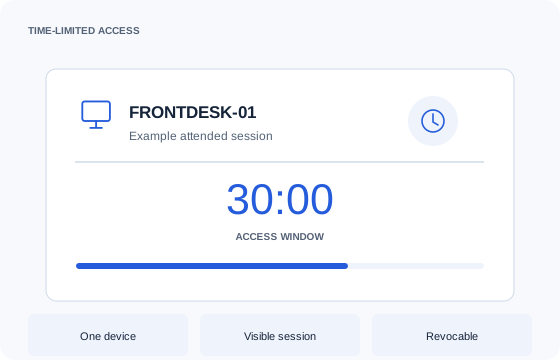
Plan work around the access window. If a job needs a new session, establish a new valid path. The support record should reflect what actually happened rather than implying that the original authorisation extended indefinitely.
Remote Login
Hard tenant isolation
A client organisation owns its devices and records. Requests are scoped to the organisation the caller is authorised to use. A request outside that boundary must not disclose another client’s device, session or membership simply because an identifier was guessed or copied.
The same boundary matters for reads and changes. It is not enough for the device list to look filtered if a direct request can retrieve or modify something outside it. Authorisation belongs with the operation, not just with the page displaying it.
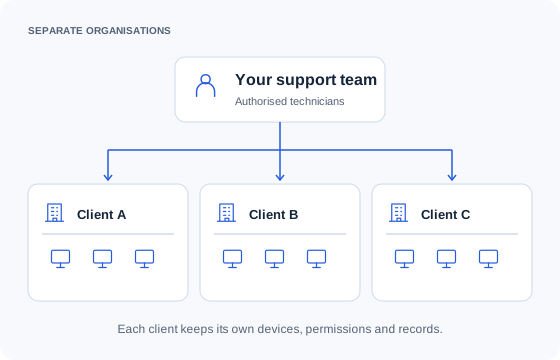
For providers, separate clients into separate organisations from the beginning. For internal teams, use the correct membership and role model for the business. Shared accounts and miscellaneous client folders make the human side of accountability weaker even when the software’s checks are sound.
See the organisation model for MSPs and the internal IT security-review guide for the operating context. A useful evaluation includes a deliberately restricted account, so that the boundary is exercised rather than merely described.
Remote Login
Two-factor for technicians
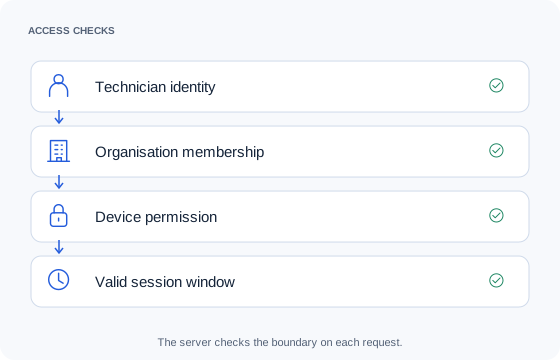
Technician sign-in supports TOTP two-factor authentication. The additional factor is separate from the password and helps protect an identity that can reach business devices. Individual technician identities also make the session record attributable to the person who did the work.
Two-factor authentication is not a substitute for correct permissions. An authenticated technician can still be outside the organisation or role needed for a particular action. Authentication establishes the identity; authorisation decides what that identity may do.
Treat recovery and staff changes as part of the deployment. Decide who administers access, how the team verifies a recovery request and what happens when a technician leaves. A shared login defeats attribution even if everyone on the team knows its second-factor code.
Remote Login
Verified capability, not assumed
The enrolment wizard checks screen, pointer and keyboard capability on the actual machine. It does not assume that a successful install means full control. A device that can only be viewed should be labelled accordingly before somebody depends on remote input.
Capability is different from authority. A Mac may permit input technically, while the technician has no right to use that device. Conversely, an authorised technician may encounter an OS permission that prevents control. Both checks must succeed for the intended action.

The platform capability matrix sets out these limits. Recheck after relevant operating-system, agent or permissions changes; a test result is evidence about a configuration, not a permanent guarantee.
Remote Login
What we log, and what we do not
- Technician
- Marcus Ellery
- Organisation
- Northline Dental
- Device
- FRONTDESK-01
- Started
- 09:41:07 UTC
- Ended
- 09:41:33 UTC
- Transfer event
- 2 files
session.ended · record retained
The access record identifies the technician, organisation, device and session timing, with relevant activity events such as file transfers. That supports a specific question: who reached which machine, and when? It is not automatically a video recording or transcript of every action.
Screen content necessarily becomes visible during a viewing session. The organisation and technician must handle that information appropriately, including avoiding unnecessary exposure and ending the session when the support work is complete. Do not put sensitive content into a support request when it is not needed.
Data categories and retention are described in the Privacy Policy. If a buyer needs a fixed retention term, recording capability, export format or particular legal agreement, confirm it in the evaluation. We will not turn an unanswered requirement into a security badge.
Remote Login
What we will never build
- An invisible mode for watching somebody without their knowledge.
- A covert monitoring workflow disguised as routine support.
- A promise that a technician can bypass the device owner’s required consent.
- A claim that an operating system permits a capability it does not expose.
The Acceptable Use Policy prohibits stalkerware, unauthorised access and tech-support fraud. Reports are handled as abuse matters, not as requests for an additional product feature. A commercial subscription does not authorise access to a device.
For a concrete view of the controls, follow a session from enrolment to retained record. For purchasing, the published plans separate commercial allowances from the access rules that apply to every legitimate session.
Questions, answered
Security questions
Is there an invisible mode?
No. Remote Login is designed for visible, authorised remote support. Attended access requires the user’s acceptance; unattended access is agreed in advance by the account owner. It is not a product for covert monitoring, stalkerware or access obtained through deception.
Does consent replace a technician’s permissions?
No. The user’s consent and the technician’s authorisation are different requirements. A consent prompt does not allow a technician to cross organisation boundaries, and a technician role does not erase a required device-side prompt. The intended action must satisfy both checks.
Do you claim SOC 2 or HIPAA certification?
This page makes no certification claim. It describes the access and consent mechanisms in the product. Buyers must assess their own configuration, policies, contracts and regulatory obligations. Bring a specific requirement into the evaluation so that it can be answered directly.
Who operates the service?
Remote Login is built and operated by Houston IT Developers LLC in Houston, Texas. The company is responsible for the service described here. Customers remain responsible for their authority to access devices and for managing the identities and permissions in their accounts.
Get started
See how it fits your team.
Tell us how many technicians you have and which platforms you support. We will help you check the fit.