Remote Login / Remote desktop software
Remote desktop software that bills per technician
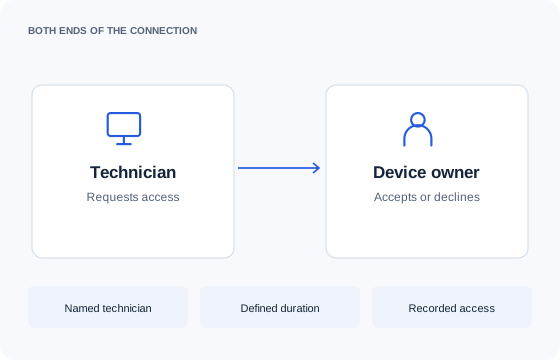
Remote desktop software brings another computer’s screen and controls to your device. The useful distinction is what surrounds that connection: permission to begin, limits while it runs, and an account of what happened afterwards.
Remote Login
What remote desktop software is, and what it is not
The category includes tools for reaching your own workstation, helping someone in front of their computer, and maintaining a fleet when nobody is at the desk. They share a connection mechanism, but the responsibilities are different. Reaching your own machine is not the same job as entering a customer’s business network.
Microsoft’s Remote Desktop Services overview describes its protocol and hosting model. It is a useful primary reference when the requirement is centrally hosted Windows desktops or applications. That architecture is distinct from helping a person on the desktop already running on their own workstation.
When comparing remote desktop programs, write down whether you need the existing user session, a separate hosted desktop, terminal administration or only a screen broadcast. Also state whether the person must be present. This short description avoids buying an access mechanism and expecting it to supply a support relationship it was never designed to manage.
For a business support team, start with the relationship. Who owns the device? Who can authorise access? Will someone be present? Do several customer organisations share the provider’s console? Answering those questions narrows the choices more effectively than comparing a list of operating-system logos.
Remote desktop software vs RDP
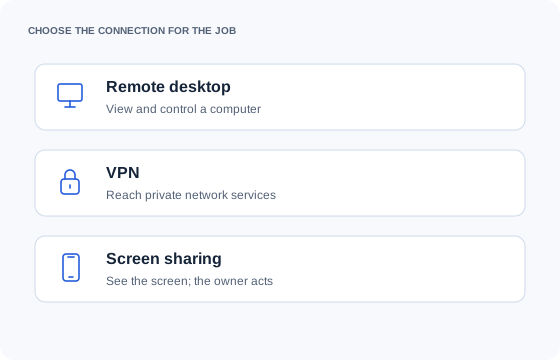
RDP is Microsoft’s Remote Desktop Protocol. It provides a remote desktop session on supported systems. It is one way to deliver remote access, not a complete substitute for a provider’s consent, tenancy, billing and audit workflow. Use an appropriately secured RDP deployment when you administer a compatible environment and can manage its access controls.
A remote support platform wraps a broader workflow around the connection: device enrolment, technician identities, client separation and session records. Choosing it does not remove the need to secure the underlying computers or to authorise the people working on them.
Remote desktop software vs a VPN
A VPN provides a protected network path. It does not, by itself, display a remote screen or move a pointer. A remote desktop application provides that interaction. Use a VPN when the task needs network access to private services; use a desktop tool when the task needs a desktop. Sometimes a controlled environment needs both.
Remote desktop software vs screen sharing
Screen sharing lets one person see what is on another screen. Remote control adds input such as keyboard and pointer actions. Use viewing when the owner can perform the steps, when you are teaching a workflow, or when the operating system does not permit third-party control. Do not infer control from the fact that a screen is visible.
Remote Login
Choose the connection that fits the job
| Tool or mechanism | What it provides | Use this when |
|---|---|---|
| Remote desktop or support platform | A device session plus its access workflow. | You need to work on a remote machine and account for the access. |
| RDP | A remote desktop protocol for supported hosts. | You control a compatible, securely configured environment. |
| VPN | A network path to private resources. | You need private network services, with a separate tool for desktop interaction. |
| Screen sharing | A view of the screen; input may remain local. | The person at the device can perform the actions, or control is unavailable. |
These distinctions prevent a common buying mistake: selecting a tool because its homepage says “remote access” and discovering that it solves a different part of the problem. A file-access product, a private network tunnel and a support console can all be described with that phrase. Specify the action you need on the far end.
For example, a technician helping a colleague with an application may need to see the same desktop the colleague sees. An administrator maintaining a server may need a terminal. An iPhone support call may need only a broadcast and clear instructions. One generic tick beside “mobile” does not answer those three cases.
Remote Login
The two things that separate good remote desktop software from cheap
What happens when the connection is refused
A refusal must be a meaningful outcome. The technician should know that the user declined, rather than guessing whether a session failed because of the network. The user should know that declining leaves them in control. This is especially important when a support provider is an unfamiliar name to the person using the computer.
The appropriate follow-up is communication: confirm the requester, explain the task and try again only with authority. Making a prompt harder to see or treating it as something to work around would undermine the reason it exists.
What exists afterwards
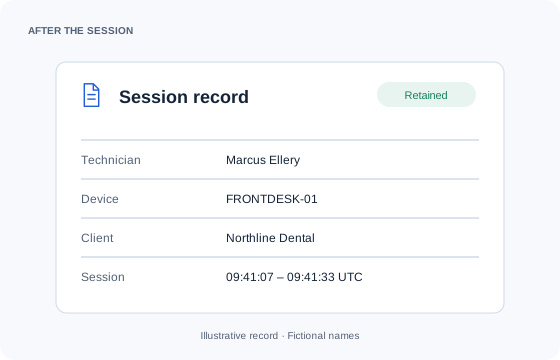
The session should leave a record tied to the correct organisation. That record needs an identifiable technician and device, with timing and outcome. The Remote Login security model describes the access checks and audit boundary; it does not claim that a log replaces every contractual, privacy or compliance requirement.
Ask a prospective vendor to show you both outcomes in a test. Decline one session, accept another, then inspect the records. A connection demo that only proves the happy path is not enough to evaluate a tool that people will use on customers’ machines.
Remote Login
Platform support, stated honestly
Our platform support reference separates unattended access, viewing, input, file transfer and terminal access. Windows, macOS and Linux do not share identical permission models, and mobile devices are not small desktop computers.
On macOS, screen visibility and input permission are separate. A technician may see the desktop before Accessibility has been granted. On Linux, a graphical session and display-server configuration affect the answer. For a headless server, a terminal is often the relevant capability.
Android unattended control is a deployment question involving device ownership and supported management configuration. iOS and iPadOS do not let a third-party support app inject system-wide touch events. Remote Login’s phone support therefore uses attended sharing and guidance. Apple’s own FaceTime control does not grant that capability to other vendors.
The setup wizard checks what the target can actually do. A successful installer is not evidence that the screen, pointer and keyboard all work. Make those separate acceptance checks part of a pilot before enrolling a fleet.
Remote Login
What it costs, and what it does not cost
Remote Login prices the support team rather than each connection. Starter is $25 per technician per month with 100 devices per seat and one organisation. Agency is $45 with 250 devices per seat and unlimited client organisations. White-Label Pro is $75 with unlimited devices and organisations.
Device allowances are real limits. “No metered overage” means a larger fleet requires a deliberate seat or plan change, not that the Starter plan becomes unlimited. Nor does an unlimited organisation allowance remove the duty to keep each client’s data separate.
See the full remote desktop pricing calculation for examples and a calculator. We do not claim to be the cheapest choice for every number of technicians, devices or simultaneous sessions. Different vendors sell different units; converting them into a single number without assumptions can be misleading.
If you support machines you do not own, the page you actually want is remote desktop software for IT support. Providers serving multiple businesses should also read the MSP workflow; teams supporting colleagues can use the internal IT review guide.
Questions, answered
Remote desktop software questions
Is remote desktop software the same as remote access software?
Remote desktop software is one kind of remote access software. It focuses on a computer’s desktop and input. Remote access can also refer to files, terminals or private networks. For support procurement, specify the actual task and the access record you need, rather than relying on the category name.
Can I use this to reach my employer’s login portal?
Remote Login is a commercial support platform for authorised IT teams, not an employer login directory. If you need your company’s portal, ask your own IT team for its address and sign-in process. Do not enter work credentials into a page merely because its name includes “remote login.”
Does a VPN make a remote session authorised?
No. Network reachability does not establish permission to use a device. You still need the owner’s authority, a permitted technician identity and appropriate session controls. Keep network access, application authorisation and user consent distinct in your support policy.
Will remote desktop software control an iPhone?
A third-party support app cannot control the iPhone’s system interface. It can support attended sharing within Apple’s APIs. Read the iPhone control explanation, including the distinction from Apple’s own FaceTime feature.
Get started
See how it fits your team.
Tell us how many technicians you have and which platforms you support. We will help you check the fit.